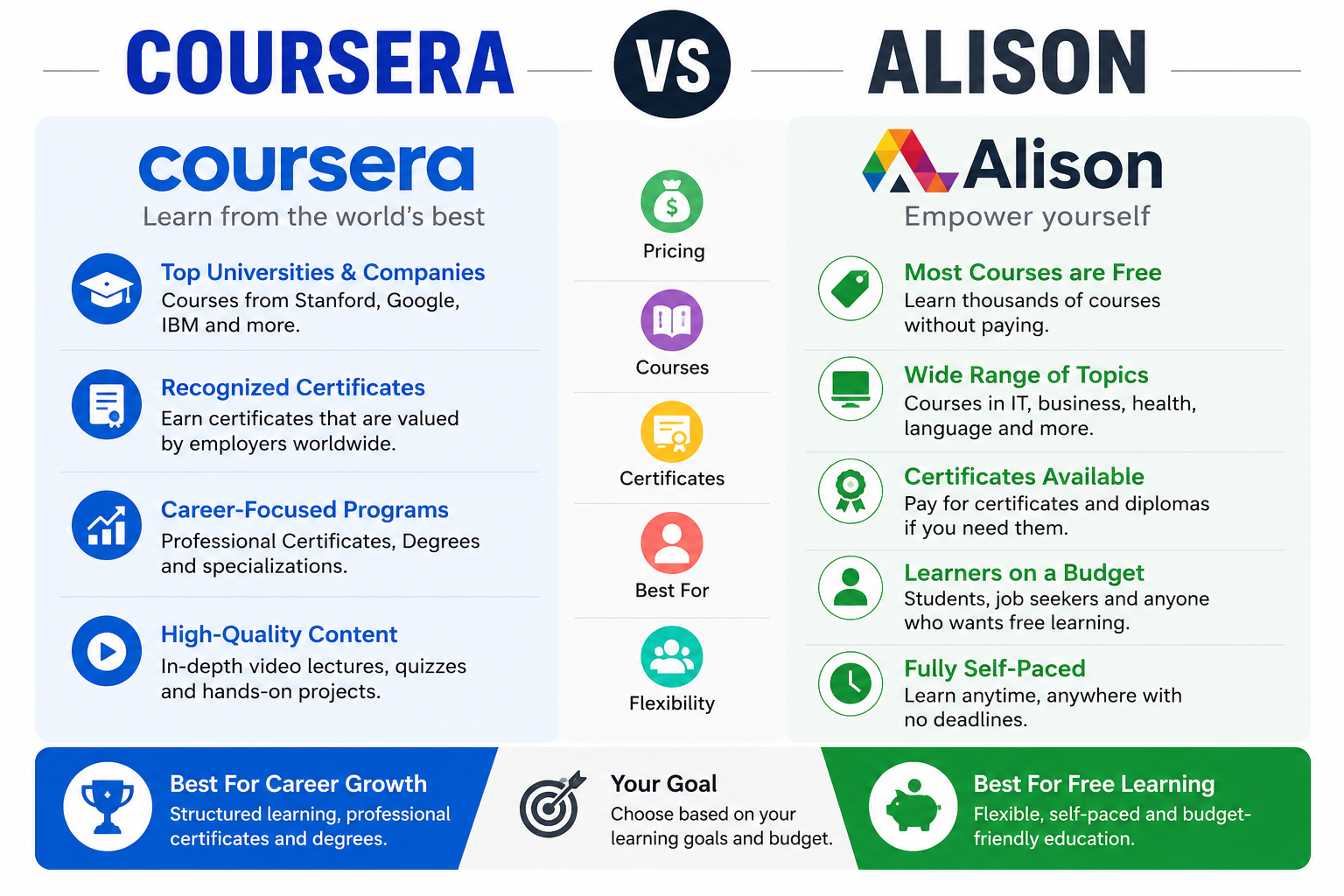
In the Coursera vs Alison comparison, learners often try to figure out which platform offers better value for their goals. Both platforms provide online courses and certifications, but they differ significantly in terms of pricing, course quality, accreditation, and career relevance.
Coursera is known for its university-backed programs and professional certificates, while Alison focuses on free learning and accessible skill development. This makes the decision between them dependent on what you want to achieve—whether it’s career advancement, formal recognition, or flexible, budget-friendly learning.
In this article, we’ll break down Coursera vs Alison across key factors to help you choose the right platform with confidence.
Table of Contents
Overview of Coursera and Alison
In the Coursera vs Alison comparison, both platforms offer online courses and certifications, but they differ in terms of course quality, pricing, accreditation, and target users.
Coursera is one of the most popular online learning platforms in the world. It partners with top universities and companies such as Google, IBM, and Stanford University to offer professional certificates, degree programs, and career-focused courses. Coursera is known for high-quality content, recognized certifications, and structured learning paths that are useful for students and working professionals.
Alison, on the other hand, focuses heavily on free online education. The platform offers thousands of free courses across business, technology, healthcare, personal development, and more. Alison is especially popular among learners looking for budget-friendly skill development and short certification courses without committing to expensive subscriptions.
One major difference in the Coursera vs Alison comparison is credibility and academic partnerships. Coursera works directly with universities and major employers, which gives its certificates stronger recognition in many industries. Alison provides certificates as well, but they are generally more suitable for personal learning, entry-level skills, and continuing education rather than formal academic credentials.
Another key distinction is the learning experience. Coursera courses often include graded assignments, peer-reviewed projects, guided schedules, and university-style lectures. Alison courses are typically more flexible and self-paced, making them easier for casual learners or people with limited time.
Overall, both platforms have strengths depending on your goals. If you want career advancement, professional certificates, or university-backed programs, Coursera may be the better option. If your priority is free learning and accessible short courses, Alison can be an excellent choice.
Course Variety and Subject Selection
When comparing Coursera vs Alison, course variety is one of the most important factors to consider. Both platforms offer thousands of online courses, but the type of content and learning structure are quite different.
Coursera focuses heavily on academic and professional education. The platform offers courses in areas such as data science, business, computer science, marketing, healthcare, artificial intelligence, and project management. In addition to individual courses, Coursera also provides Specializations, Professional Certificates, and full online degree programs from universities and major companies.
One of Coursera’s biggest strengths is its partnerships with institutions like Yale University, the University of Michigan, and Meta. This allows learners to access university-level education and career-focused training in a structured format.
Alison also offers a wide range of subjects, including business, IT, health, language learning, personal development, sales, and entrepreneurship. However, Alison’s courses are generally shorter and more beginner-friendly. The platform is designed for quick skill development rather than long academic programs.
In the Coursera vs Alison comparison, Coursera is usually the better option for learners seeking in-depth education or industry-recognized career paths. Alison is often a stronger choice for users who want free introductory courses or practical skills they can learn quickly.
Another difference is the learning format. Coursera organizes many courses into step-by-step learning paths that help students progress from beginner to advanced levels. Alison focuses more on standalone courses that can be completed independently at your own pace.
Overall, both platforms provide excellent course variety, but the best choice depends on your goals. Coursera is ideal for structured professional learning, while Alison works well for flexible and affordable self-improvement.
Course Quality and Instructors
When evaluating Coursera vs Alison, course quality is one of the biggest differences between the two platforms. While both offer online learning opportunities, the depth of content and instructor credentials vary significantly.
Coursera is widely known for its high-quality academic and professional courses. Many programs are created in partnership with leading universities and global companies, including Yale University, University of Michigan, Google, and IBM. These courses are often taught by university professors, industry experts, and experienced professionals.
Coursera courses usually include video lectures, graded assignments, quizzes, peer-reviewed projects, and downloadable resources. Many programs also follow a structured curriculum that builds skills step by step. This makes Coursera especially useful for learners who want a more academic or career-focused experience.
Another advantage in the Coursera vs Alison comparison is production quality. Coursera courses often have professionally recorded lectures, interactive exercises, and detailed learning materials. The platform is designed to feel similar to a university-level online classroom.
Alison also provides quality educational content, but the teaching style is generally simpler and more focused on accessibility. Alison works with various publishers, trainers, and educational organizations to create courses in business, IT, healthcare, language learning, and personal development.
Most Alison courses are shorter and easier to complete, making them ideal for beginners or casual learners. However, compared to Coursera, Alison courses may not always offer the same depth, instructor reputation, or academic rigor. The platform focuses more on practical skill-building and affordable learning rather than university-style education.
Overall, if you are looking for expert-led courses with strong academic credibility and professional recognition, Coursera is usually the stronger option. If you want quick, beginner-friendly courses for personal development or basic job skills, Alison can still provide excellent value
Certificates and Accreditation
In the Coursera vs Alison comparison, certificates and accreditation play a major role for learners who want recognized qualifications and stronger career opportunities.
Coursera is well known for offering certificates from respected universities and global companies. Many courses are created in partnership with institutions such as Duke University, the University of London, and Google. After completing a paid course or program, learners receive a verified certificate that can be added to LinkedIn profiles, resumes, and job applications.
One of Coursera’s biggest advantages is that some of its programs provide professional certificates and even accredited online degrees. These credentials are generally recognized by employers and can carry real value in competitive industries such as IT, business, data science, and project management.
In the Coursera vs Alison comparison, Coursera is usually considered the stronger option for career-focused certifications because of its university partnerships and employer-backed programs.
Alison also offers certificates and diplomas for course completion. Many of its courses are free to study, but learners typically need to pay if they want an official digital or printed certificate. Alison certificates can demonstrate initiative and self-learning, especially for entry-level skills or personal development.
However, Alison certificates are not usually viewed the same way as university-backed certifications from Coursera. While Alison provides valuable educational content, its credentials are generally better suited for skill-building rather than formal academic recognition.
Another important difference is accreditation. Coursera works directly with accredited universities and institutions, while Alison focuses more on independent online education and CPD-style learning. This does not make Alison ineffective, but it does mean the platform serves a different purpose.
Overall, if your goal is to earn credentials that employers and universities are more likely to recognize, Coursera is typically the better choice. If you simply want affordable learning and proof of course completion, Alison can still be a useful platform.
Pricing and Free Course Options
When comparing Coursera vs Alison, pricing is one of the most important deciding factors, especially for learners who want to gain skills without spending too much.
Coursera operates on a mixed pricing model. Many courses can be audited for free, meaning you can access video lectures and some materials without paying. However, if you want a certificate, graded assignments, or full course access, you usually need to pay. Coursera also offers subscription-based plans like Coursera Plus, which gives access to a large catalog of courses for a monthly or yearly fee. In addition, some programs, such as professional certificates and degree courses, are priced higher due to their depth and accreditation.
In the Coursera vs Alison comparison, Coursera is generally more expensive, but it provides structured learning paths and certificates that often carry higher professional value.
Alison is known for its strong focus on free education. Most courses on Alison are completely free to study, which makes it one of the most accessible learning platforms available online. Learners can access full course content without paying, which is a major advantage for those on a tight budget.
However, Alison generates revenue by charging for optional certificates, diplomas, and physical copies of credentials. This means you can learn for free, but you may need to pay if you want proof of completion.
Another key difference in the Coursera vs Alison comparison is value structure. Coursera charges for structured, career-oriented programs, while Alison keeps learning for free but monetizes certification. This makes Alison more attractive for casual learners and Coursera more suitable for professional development.
Overall, Coursera is better for learners willing to invest in career growth and recognized certifications, while Alison is ideal for those who want free access to a wide range of courses.
Learning Experience and Platform Usability
In the Coursera vs Alison comparison, how each platform is designed for learning and how easy it is to navigate can significantly affect user engagement and course completion.Coursera offers a structured and highly organized learning environment. The platform is designed to feel similar to a university-style classroom, with clear weekly modules, progress tracking, graded assignments, and peer-reviewed projects. This structured approach helps learners stay on track, especially in longer or more advanced courses.
Coursera also provides features like mobile learning through its app, downloadable videos for offline study, and integrated discussion forums where learners can interact with peers and instructors. In the Coursera vs Alison comparison, Coursera stands out for its polished interface and strong focus on guided learning paths.
provides a simpler and more flexible user experience. The platform is easy to navigate, with courses typically organized into short modules that learners can complete at their own pace. Alison is designed for quick access to learning materials, making it ideal for users who prefer a straightforward and less structured experience.
However, unlike Coursera, Alison does not offer as many advanced learning tools, such as peer-reviewed assignments or in-depth progress tracking. Instead, it focuses on accessibility and speed, which works well for casual learners or those looking to gain basic skills quickly.
In the Coursera vs Alison comparison, Coursera provides a more immersive and structured educational experience, while Alison prioritizes simplicity and ease of use.
Overall, Coursera is better suited for learners who want a guided, academic-style experience with strong support features, while Alison is ideal for those who prefer fast, flexible, and self-directed learning.
Career Support and Job Value
When it comes to comparing Coursera vs Alison, career support and job relevance are key factors for learners who want to use online courses to improve employment opportunities. It It
is strongly focused on career development and job readiness. The platform partners with major employers and industry leaders such as Google, IBM, and Amazon to create job-relevant training programs. Many of these programs are designed specifically to prepare learners for entry-level roles in fields like data analytics, IT support, digital marketing, and project management.
A major advantage in the Coursera vs Alison comparison is Coursera’s Career Certificates and guided learning paths. These programs often include hands-on projects, real-world case studies, and portfolio-building assignments that help learners demonstrate practical skills to employers. Coursera also integrates with LinkedIn, allowing users to showcase completed certificates directly on their profiles.
also offers value for career development, especially for entry-level learners. The platform provides courses that help users build foundational skills in business, technology, communication, and personal development. However, Alison focuses more on general skill-building rather than structured job placement support.
While Alison certificates can demonstrate learning initiative, they are not typically tied to employer recruitment pipelines or formal career pathways. In the Coursera vs Alison comparison, this makes Alison more suitable for improving basic skills or supporting early-stage career exploration rather than direct job preparation.
Another key difference is the level of career guidance. Coursera offers structured career tracks, skill assessments, and sometimes job placement assistance through partner programs. Alison, on the other hand, does not provide extensive career services, but it does offer tools like CV-building resources and general employability courses.
Overall, Coursera is generally stronger for learners who want direct career advancement, industry recognition, and job-ready skills, while Alison is better suited for learners focused on self-improvement and foundational knowledge.
Flexibility and Learning Pace
In the Coursera vs Alison comparison, flexibility and learning pace differ mainly in how structured each platform is. offers a mostly self-paced learning experience, but with more structure than many other online platforms. Many courses follow weekly modules, recommended schedules, and deadlines for assignments or peer-reviewed work. This structure helps learners stay consistent, especially in longer programs such as Professional Certificates or Specializations.
In the Coursera vs Alison comparison, Coursera is better suited for learners who want flexibility but still benefit from guided timelines and structured progression. Some courses allow full self-paced access, while others may have fixed start and end dates, especially cohort-based programs or university-led courses.
is designed for maximum flexibility. All courses are fully self-paced, meaning learners can start and finish at any time without deadlines or schedules. This makes Alison particularly attractive for users who prefer complete control over their learning pace.
A key advantage of Alison in the Coursera vs Alison comparison is that learners can pause and resume courses at any time without losing progress or worrying about time limits. This makes it ideal for casual learners or individuals with unpredictable schedules.
However, while Alison offers greater flexibility, it provides less structured accountability. Coursera’s scheduled modules and progress tracking can help learners stay motivated and complete more complex programs, especially in technical or career-focused fields.
Overall, Coursera provides a balanced approach with structured flexibility, while Alison prioritizes unrestricted, fully self-paced learning
Pros and Cons of Coursera vs Alison
In the Coursera vs Alison comparison, evaluating the strengths and weaknesses of each platform helps clarify which one is better suited for different types of learners.
Pros and Cons of Coursera vs Alison
When comparing Coursera vs Alison, it is helpful to look at the advantages and limitations of each platform side by side. Both platforms are useful, but they serve different learning needs.
Coursera Pros
- Offers courses from top universities and global companies such as Google and IBM
- Provides professional certificates and accredited programs
- Strong career-focused learning paths
- High-quality video lectures and structured coursework
- Recognized by many employers
Coursera Cons
- Most certificates require payment
- Some courses have strict deadlines
- Can feel overwhelming for beginners due to the academic structure
- Subscription plans can be expensive for long-term learners
Alison Pros
- Most courses are free to access
- Wide range of beginner-friendly topics
- Fully self-paced learning with no deadlines
- Simple and easy-to-use platform
- Good for basic skill development and personal learning
Alison Cons
- Certificates usually require payment
- Less academic or employer recognition compared to Coursera
- Fewer advanced or in-depth professional programs
- Limited structured learning paths
In the Coursera vs Alison comparison, Coursera is generally stronger for career advancement and formal learning, while Alison is better suited for free education and flexible self-improvement.
Who Should Choose Coursera vs Alison?
Choosing between Coursera and Alison comes down to what you want to achieve, how much you’re willing to spend, and the type of learning experience you prefer. Each platform is built for different learner needs, so identifying the right fit is important before you start.is best suited for learners who want structured, career-focused education. It is a strong option for students, professionals, and career changers who are looking to gain industry-recognized certificates or build skills for specific roles. Because Coursera partners with organizations like Google and IBM, its programs are often aligned with real job requirements in fields such as data science, IT, business, and project management.
In the Coursera vs Alison comparison, Coursera is the better choice if you:
- Want certificates with strong employer recognition
- Prefer structured learning paths and guided progress
- Are willing to invest in career development
- Need in-depth, professional-level training
is better suited for learners who want free, flexible, and self-paced education. It is especially useful for beginners, students exploring new subjects, or individuals looking to build basic skills without financial commitment.
In the Coursera vs Alison comparison, Alison is ideal if you:
- Want completely free access to learning materials
- Prefer short, simple, and flexible courses
- Are focused on personal development or basic skills
- Do not require formal or highly recognized certifications
Coursera generally fits learners who are focused on long-term career growth, while Alison works well for those who prioritize accessibility and affordability.
Frequently Asked Questions
When comparing Coursera vs Alison, many learners have similar questions about certificates, pricing, and career value. Below are clear answers to the most common ones.
Is Coursera better than Alison?It
is generally better for career-focused learning because it partners with universities and companies like Google and IBM. It is better for free, flexible learning and basic skill development. In the Coursera vs Alison comparison, “better” depends on whether you want professional credentials or free education.
Image suggestion: Side-by-side logo comparison of Coursera and Alison.
Are Alison’s certificates worth it?
Alison certificates can be useful for showing that you completed a course and developed basic skills. However, they are generally not as widely recognized by employers as Coursera certificates, especially in competitive industries.
Do Coursera certificates help with jobs?
Yes. Coursera certificates are often designed with employer input and can improve job prospects, especially in fields like IT, data science, and business. Many programs are part of structured career tracks.
Image suggestion: Coursera Career Certificate or portfolio project screenshot.
Is Coursera free or paid?
Coursera offers some free course content, but certificates and full access usually require payment. There are also subscription options like Coursera Plus.
Is Alison completely free?
allows free access to most course content, but certificates and diplomas typically require payment if you want official proof of completion.
Which is better for beginners: Coursera or Alison?
In the Coursera vs Alison comparison, Alison is often better for beginners because it is simple, free, and flexible. Coursera is better if you want structured learning with long-term career goals.
Can I get a job using Alison or Coursera?
Coursera is more directly linked to job preparation through career certificates and employer partnerships. Alison can help build foundational skills, but it is less commonly used as a direct hiring credential.
Final Verdict: Is Coursera or Alison Better?
There isn’t a universal “best” choice in Coursera vs Alison—the right platform depends on whether you prioritize recognized career credentials and structured learning or free, flexible access to courses for personal skill development. The stronger choice if your priority is career advancement, professional certificates, or structured learning from recognized institutions and companies like Google and IBM. It is especially valuable for learners who want job-ready skills, accredited programs, and credentials that are more widely recognized by employers.
, on the other hand, is best suited for learners who want free access to education, flexible self-paced study, and basic skill development. It is a practical option for beginners, casual learners, or anyone who wants to explore new topics without financial commitment.
In the Coursera vs Alison comparison, the key difference is purpose: Coursera focuses on structured, career-oriented education with higher credential value, while Alison emphasizes accessibility and free learning opportunities.